Dress Codes and the Work Force: The Cost of Women’s Liberation
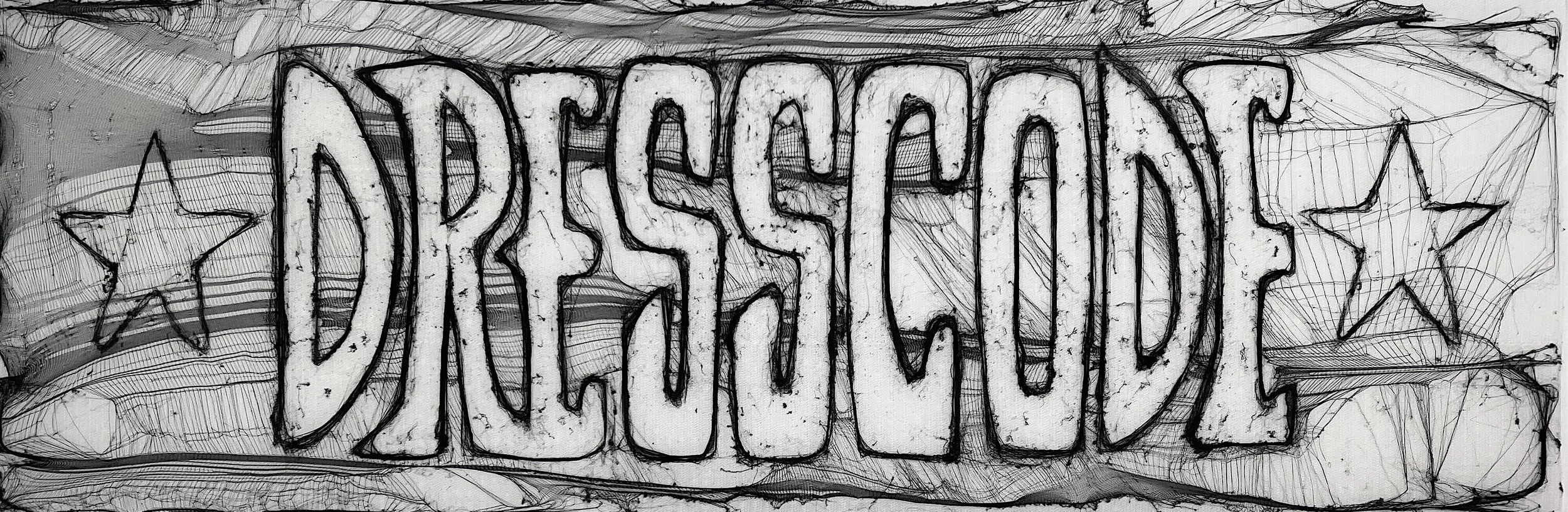
“DRESSCODE” original nylons on hook artwork pictured above is available to acquire. Click Here to email Lucine for inquiries.
We tend to talk about women’s liberation as a victory with clean edges. More access to work. More autonomy. More visibility. A forward march away from domestic confinement and toward independence. But that narrative rarely lingers on the fine print. Liberation did not arrive without conditions, and many of those conditions were placed directly onto women’s bodies.
When women entered the workforce in large numbers, they were not entering a neutral space. The workplace had already been designed around male bodies, male comfort, and male standards of professionalism. Women were permitted to participate, but only if they could adapt themselves accordingly. Their bodies had to be managed, refined, controlled, and visually disciplined. Liberation came with an unspoken requirement: do not disrupt the system.
Pantyhose became a quiet emblem of this contract. Marketed as modern, essential, and professional, they promised polish and uniformity. They smoothed skin, concealed texture, and standardized appearance. When they functioned correctly, they disappeared. When they failed—when they ran, tore, or sagged—the failure was public and immediate. The woman, not the garment, bore the blame.
This is where the cost of liberation becomes visible. Access to work did not free women from bodily scrutiny; it intensified it. Women were expected to perform competence and femininity simultaneously, often in contradiction. Their bodies had to be both present and unobtrusive, expressive yet controlled, visible yet seamless. The labor required to maintain this balance was constant and largely invisible.
Time was spent preparing. Money was spent maintaining. Discomfort was normalized. Restriction was aestheticized. These were not framed as sacrifices but as personal responsibilities. The body became a site of continuous upkeep in order to remain employable, respectable, and “appropriate.”
Who paid that cost? Women did. With their time, their money, their comfort, and their bodies.
My work is rooted in this tension. I work with worn, stretched, and torn pantyhose not as a symbol, but as evidence. These materials hold memory. They record pressure, repetition, and strain. They remember bodies that official histories tend to smooth over. In tearing and reassembling them, I am not interested in nostalgia or fetishization. I am interested in preservation—of what was demanded quietly and endured privately.
To interrogate the cost of liberation is not to dismiss progress. It is to complicate it. It is to acknowledge that autonomy often came bundled with new forms of discipline, and that those disciplines were unevenly distributed and rarely named. The promise of freedom was real, but so was the labor required to embody it.
These questions are not historical curiosities. They linger. They show up in contemporary conversations about dress codes, professionalism, bodily autonomy, and who gets to be comfortable at work. The garments may change, but the expectations often do not.
By slowing down and looking closely at materials that were meant to be disposable, I am asking for a different kind of attention. One that recognizes the body as an archive. One that understands liberation not only by what it grants, but by what it quietly extracts.
Because until we ask who paid the price, the story of liberation remains incomplete.